The Shopee and Lazada buttons open that model’s search on each shop. If an affiliate URL is added later, we may earn a commission. Rank is not sold. The “Buy on brand site” button opens the maker’s page when we have one. Read the disclosure
How to choose an air purifier for a school
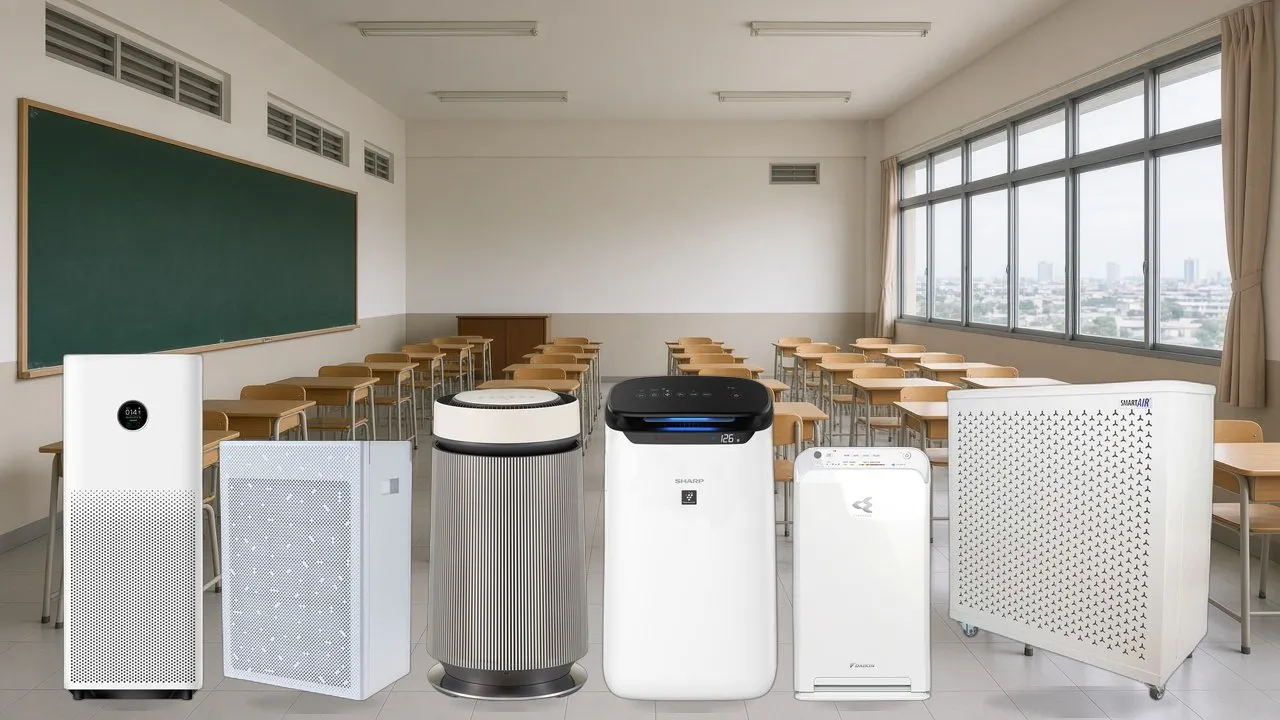
A school is many rooms. The machine only cleans the classroom it stands in. Measure that room, then read the coverage area, the CADR, and the noise at the speed you will run while class is in session. A classroom up to about 100 m² is the Blast Mini on this page. A hall or a large meeting room is a different job. Use the office guide for that space.
Check the coverage area of that classroom
Walk the room you will furnish. Multiply length by width in metres. That product is the area this machine has to cover. A second classroom, the corridor, and the floor above stay out of the sum, because a closed door stops the cleaned air.
The square metres on a model are that model’s coverage area, and brands do not all calculate them the same way. Some give a band from one test standard. Some tie the area to air changes per hour. Some print a recommended room and no CADR. Read the number with the method, when a method is named. A figure for the whole school does not say what this class gets.
For a wide room where people sit for hours, read the upper end of the coverage area, not only the smallest number on the box. One unit in a corner does not clean the next room.
Check the CADR
CADR is the clean air the machine can deliver in an hour, in cubic metres per hour. In one classroom, a higher CADR moves filtered air through that room faster. Compare it when both models print a CADR.
Airflow from the fan is a separate figure. It describes how hard the fan blows, not a tested clean-air rate. If a model lists airflow and no CADR, leave the CADR blank. Do not turn the fan number into a CADR so it can sit beside a tested model.
Tests differ. A room band, a smoke-dust-pollen split, and a fan table are not one ranking. Pair the published CADR with the coverage area from the same source.
Check the noise at class speed
The decibel that matters is the speed you will leave on while people talk or try to hear a teacher. Sleep mode and the lowest step are the quiet settings, and they usually move much less air. A very low number on that step can look attractive and still be the wrong speed for a full class. During lessons the fan is often higher, and that step is louder.
If the model prints no noise figure, do not treat it as quiet enough for a room of students. A dimmed display is not a quiet fan. Read the decibels and the speed they belong to.
Keep the intake clear, and plan the filter
The machine has to pull classroom air through the filter. A corner, a curtain, or a row of chairs across the inlet makes the fan work while little room air is cleaned. Leave the inlet and the outlet clear, and keep the unit on the floor unless the manual says otherwise.
Add the first replacement filter to the price before you buy. Filter life is not the same on every model, and the machine does not replace the building’s ventilation.